

From a wide variety of setting styles to center-stone options, modern-day engagement ring shopping comes with more options than ever. We believe that being educated on all the available up-to-date stone options when making your engagement jewelry purchase is important. Whether you prefer your center stone to be a natural diamond, laboratory-grown diamond, gemstone, or any other alternative options, all that matters is what will make you happy. The jewelry industry has seen laboratory-grown diamonds increase in popularity within the last couple of years leaving customers wanting to know more. We are here to give you all the details, so you are informed when making your purchase to find the best stone to meet your needs.
Keep reading to compare a natural diamond and a laboratory-grown diamond.
What is a natural diamond?
Keep reading to compare a natural diamond and a laboratory-grown diamond.
What is a natural diamond?
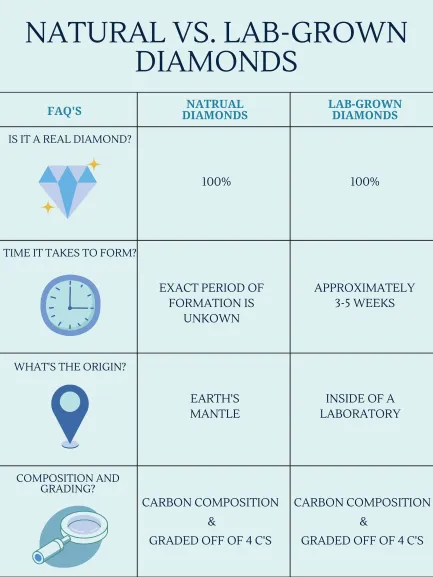
A natural diamond is a naturally occurring gemstone that forms in nature and mined from the Earth. Natural diamonds are composed solely of carbon and form in the Earth’s mantle at around 100 miles beneath the surface. They undergo extreme heat and pressure before the crystal structure is formed. Diamonds are unlike any other gem on Earth and are extraordinary because of their chemical composition, isometric crystal structure, and extreme beauty! When comparing a natural diamond to a laboratory-grown diamond, we like to refer to a natural diamond as a “below the grown” diamond.
What is a laboratory-grown diamond?
What is a laboratory-grown diamond?
A laboratory-grown diamond is grown within a laboratory. Otherwise known as lab-grown, lab-created, lab-made, or “above-grown” diamond. They are grown within a controlled environment inside of a lab using a diamond seed of a pre-existing diamond. The diamond seed undergoes a process that replicates the conditions a natural diamond undergoes in nature. A laboratory-grown diamond identically shares chemical, optical, physical properties, and crystal structure of a natural diamond. The main difference between a natural and laboratory-grown diamond is the origin of which they are formed.
Are both a natural diamond and a laboratory-grown diamond real?
Are both a natural diamond and a laboratory-grown diamond real?
Yep, and yep! Both natural and laboratory-grown diamonds are composed of carbon and share the same physical and chemical properties. They also both rank as a 10 on the Mohs scale of hardness. This means both natural and lab-grown diamonds rank the highest level of mineral hardness. Their Mohs scale of hardness ranking make both suitable for everyday wear in jewelry.
How long does it take for a natural diamond to form?
No one knows the exact time it takes to form a natural diamond, but it has been estimated to take upwards of millions and billions of years! An estimation can been made to determine how old a diamond is through a process called carbon dating. This is a common practice used for all archeological discoveries.
How long does it take for a laboratory-grown diamond to form?
A laboratory-grown diamond takes approximately 3-5 weeks to grow in conditions which replicate those in which a natural diamond that would grow underground.
How are natural diamonds and laboratory-grown diamonds graded?
Both natural and laboratory-grown diamonds undergo the exact same rigorous process of grading. The grading of both origins is based off the Four C’s: cut, color, clarity, and carat.
What is the value difference?
How long does it take for a laboratory-grown diamond to form?
A laboratory-grown diamond takes approximately 3-5 weeks to grow in conditions which replicate those in which a natural diamond that would grow underground.
How are natural diamonds and laboratory-grown diamonds graded?
Both natural and laboratory-grown diamonds undergo the exact same rigorous process of grading. The grading of both origins is based off the Four C’s: cut, color, clarity, and carat.
What is the value difference?
Natural Diamond: Historically, mined diamonds have proceeded to increase in value over time. As with any natural resource, the rarity and demand of a natural diamond plays a huge part in the monetary value.
Laboratory-grown Diamond: As a product of technology, the value of laboratory- grown diamonds is still truly unknown.
Laboratory-grown Diamond: As a product of technology, the value of laboratory- grown diamonds is still truly unknown.
Our mission is to celebrate moments of happiness and best serve our customers' needs. Both natural diamonds and laboratory-created diamonds are available for purchase at a D. Geller & Son showroom. For more information chat with a team member HERE or contact us HERE.